

Since posting the piece below I have come across Hosking Willis Architecture's Heritage Assessment of the Crown and Anchor Hotel, part of a second nomination for State Heritage listing of the pub (accessed 28 May; hopefully the report will remain available). This is a very well researched and produced document; I recommend it to anyone interested in the Crown and Anchor or pub (architecture) history in general. [Posted 29 May 2024]
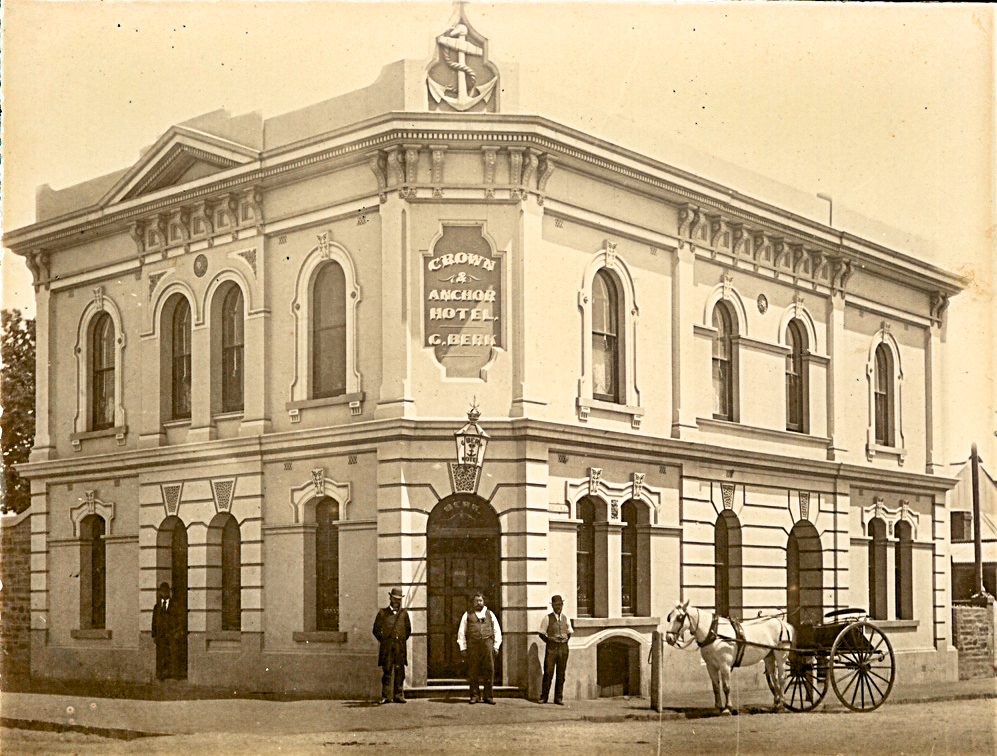
The Crown and Anchor Hotel, c.1879, soon after rebuilding. [SLSA B 9765] |
|
Development and change is not new to the Crown and Anchor. Over the past 180 or so years, there have been at least two and arguably three continuously licensed public houses on or near the site now occupied by the Crown and Anchor: the Union Inn (1847-1849, 1851-1852), the Joiner's Arms (1850) and the Crown and Anchor itself (1853 - current). The hotel itself has been rebuilt at least twice, partly to modernise its services, generally in response to its changing 'community'.
|
The site, town acre 97, was mortgaged in early 1842 from Jacob Warn to John Yabsley Wakeham, at the time described as "carpenter, builder and undertaker", evidently to subdivide, erect buildings and sell them before the mortgage expired or before he could purchase the property [LSG Memorial 66/2]. Like many colonial builders - several of my own ancestors included - Wakeham was effectively a 'developer'. He was also an inaugural Adelaide City Councillor, serving from October 1840 to at least 1845.
|
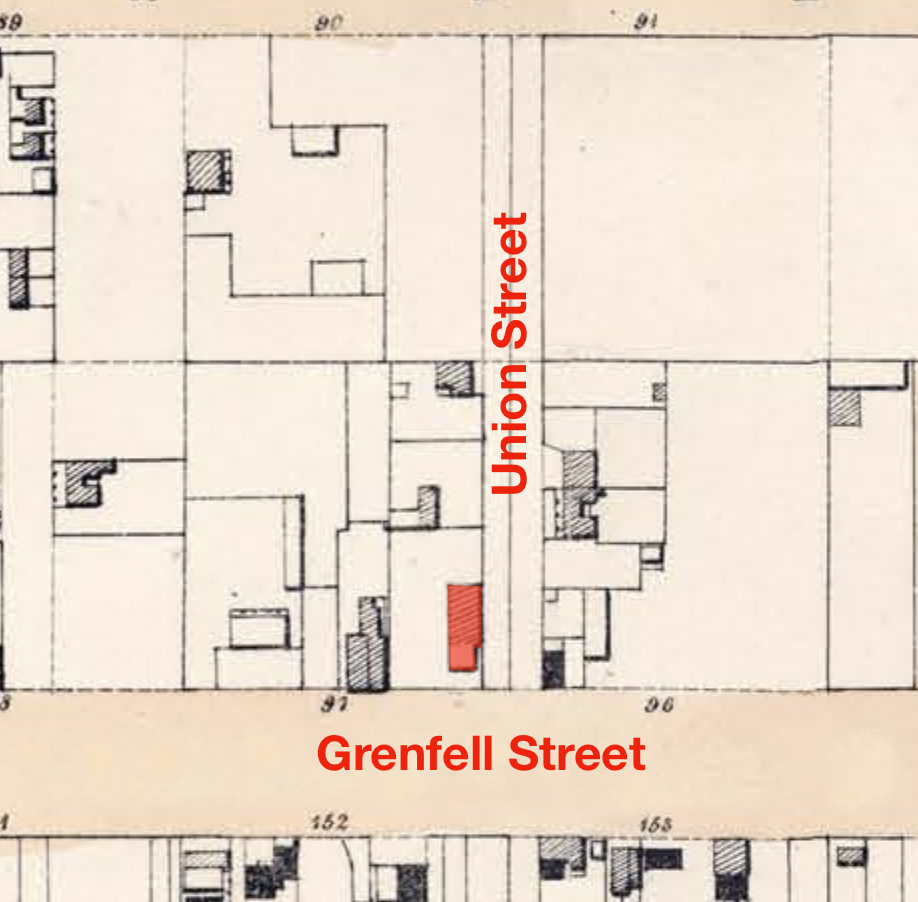
As early as January 1842 Wakeham advertised the sale of "an excellent brick house containing five rooms and cellar, well adapted for a public house, being built by the proprietor..." on "acre 97 Grenfell-Street" [Examiner, 13 January 1842, p.2]. It is possible that this was the building, owned and occupied by "J Y Wakeham", rated with a value of £36 and described in the Adelaide City Council Rate Assessment Book of 1846 as "Brick Building Five Roomed dwelling House and Garden fronting on Grenfell Street; it is also possible that this building is shown on Kingston's map of Adelaide in 1842, on the corner of Grenfell and Union Streets; see detail on the right. There is, however, no evidence that this or any other property on Town Acre 97 was 'licensed' by Wakeham or any one else until March 1847.
|
|
|
From about this time Wakeham was beset with financial problems forcing him to sell not only his "stock in trade as a builder and victualler" [South Australian, 22 June 1847, p.1; Adelaide Times, 5 March 1849, p.3; also South Australian, 24 July 1849, p.3] but also his interest in the hotel. In November 1847, Wakeham advertised, apparently without success, "to be let or sold, a freehold public house and land capable of further improvements and doing a lucrative trade" [South Australian Gazette and Mining Journal, 6 November 1847, p.1]; although not named, this could only have been the unfinished Union Inn.
Although the Magistrates renewed Wakeham's license for the Union Inn for 1848-49, it was apparent that he had been able to do little to improve the hotel over the past year [South Australian, 17 March 1848, p.2]. On 29 September 1848 Richard Bosworth, an investor, purchased the the property, including the "public house and other erections and buildings" at the same time effectively leasing the pub to William Clark, entrepreneur, and founder of the Halifax Brewery [LSG Memorial, 419/12]. Because Wakeham had "not kept his promise made long ago to increase the accomodations", in March 1850 the Bench of Magistrates refused to renew the Union's licence [South Australian, 15 March 1850, p.4]. However, at its next meeting, in June 1850, the Magistrates deemed that "the old house was [sufficiently] complete" [South Australian Gazette and Mining Journal, 13 June 1850, p.4]. For the next four or so years there followed a complicated series of changes of ownership, re-financing and leasing arrangements... and a succession of short-term licensees.
Three of these - John Fuller (1850), James Bryson or Bryceson (1851) and Thomas Melliar Phelps (1852) might well have been caretaker licensees, installed by Clark to manage the pub's "brisk outdoor trade" and to maintain the continuity of the license while the pub was being rebuilt. Although there is no direct evidence for this, it is also possible that Clark engaged William McLean, a carpenter/builder as well as an experienced publican, to complete and refurbish the pub. The Adelaide City Assessment Book for 1852 described the Union Inn as "10 rooms, stone and brick house, cellar and yard", with a rateable value of £80, "occupied" by McLean (not as would be expected by the licensee at the time, Bryson) and leased by W H Clark; at this stage the pub was a single-storied building, as recalled by an old time resident of Grenfell Street in 1919 [Register, 16 October 1919, p.5].
|
Just as it was completed and probably because of Clarks growing financial problems, in May 1852 the Union Inn was advertised for sale [South Australian Register, 28 May 1852, p.4]. In a complex four-way agreement, on 9 September 1852 Clark's lease was bought out by James Ellery [LSG, Memorial 41/43] and the next day, in a convoluted arrangement by which the vendor lent money to the purchaser, Ellery bought for £54 that portion of Acre 97 on which it was built and, explicitly, the "Public House called 'The Union Inn' and other erections and buildings thereon, Together with all houses etc" [LSG, Memorial 77/43].
|
|
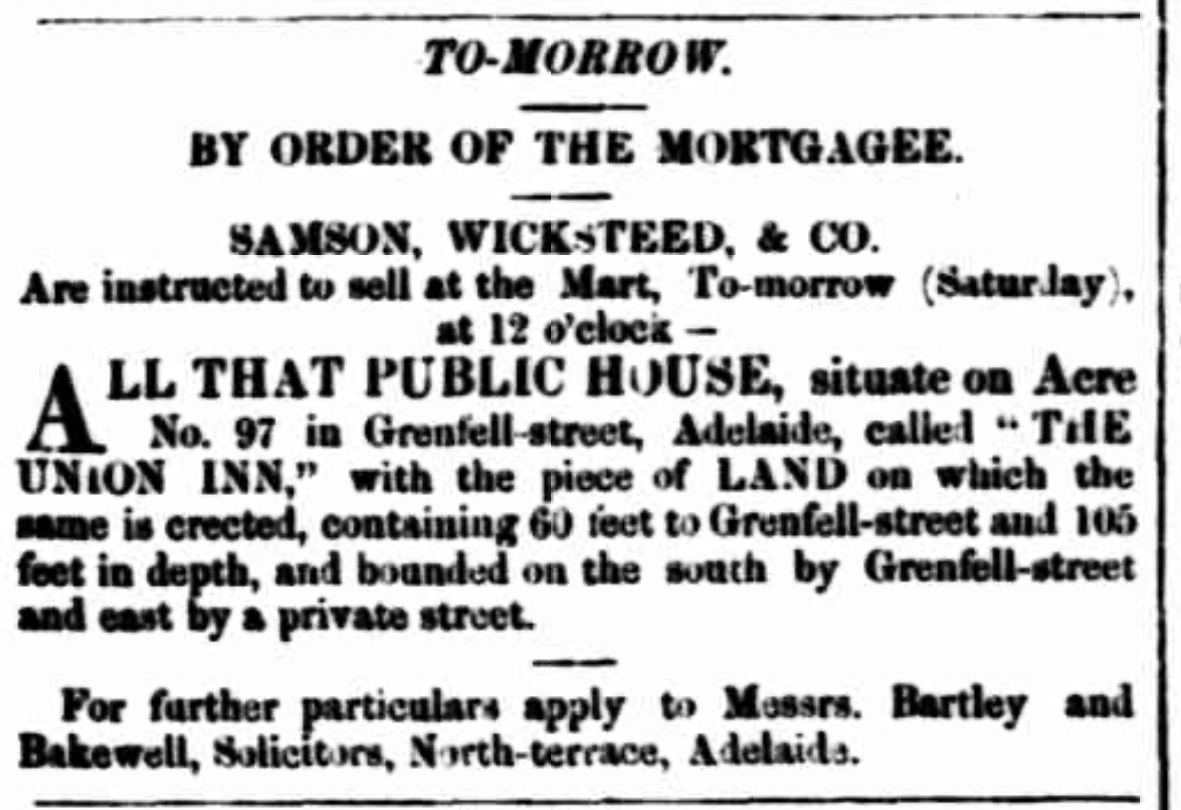
Advertisement for the Union Inn, 10 May 1852 [South Australian Register, 28 May 1852, p.4] |
|
On 15 March 1853 the pub was licensed to James Ellery [ South Australian Register. 16 March 1853, p.3] and relaunched as the Crown and Anchor Inn [South Australian Register, 30 March p.1]. As was customary, on 8 June 1853, Ellery hosted the first of a number of "exceedingly pleasant and highly respectable " balls to celebrate the opening of the rebuilt hotel and to establish its good reputation [South Australian Register, 14 June 1853, p.3]. As with the Union, the reason for the name "Crown and Anchor Inn" - or for changing the name - remains unknown.
|
|
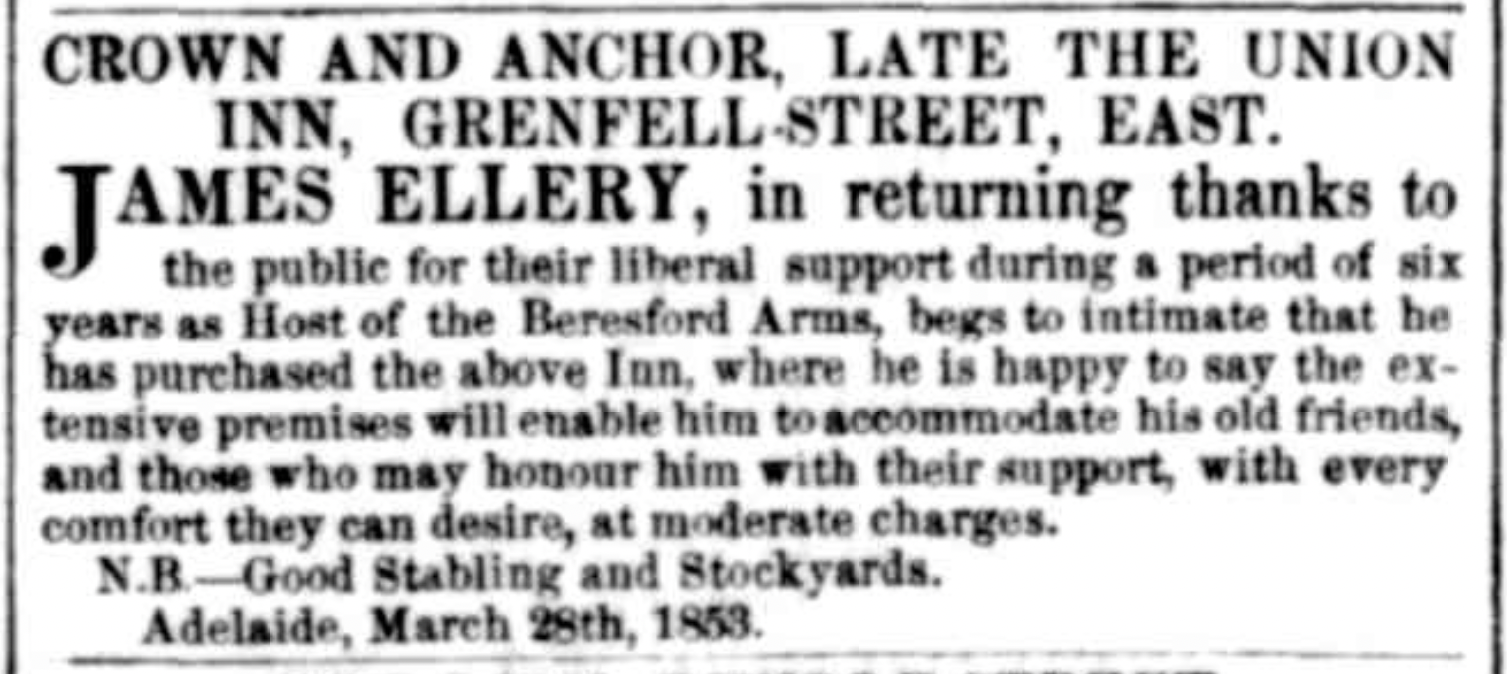
Advertisement the opening of the Crown and Anchor, 10 May 1852 [Adelaide Observer, 9 April 1863, p.1 |
Ellery's will specified that, on the death or remarriage of his wife, his entire real and personal estate, including the Crown and Anchor, be sold and the proceeds distributed amongst his beneficiaries [SRSA: GRS/1334/00001/26 File 2192, Ellery James, probate files... November 1871; The Express and Telegraph, 24 October 1873, p.2]. Consequently, on 8 May 1873 Ellery's executors auctioned "the well-known hotel, Crown and Anchor, consisting of 14 rooms, detached outbuildings, stabling, &c., at present let at £2 10s per week to a monthly tenant" and four of Ellery's neighbouring properties [South Australian Register, 26 April 1873, p.8]. For the Crown and Anchor, "there was a very brisk competition. The bidding started at £900 and the hotel was knocked down at [£1,400]" [Evening Journal, 8 May 1873, p.2]. In December 1872 the value of the pub was rated at £105 [ACC, Assessment Book 1873]!
|
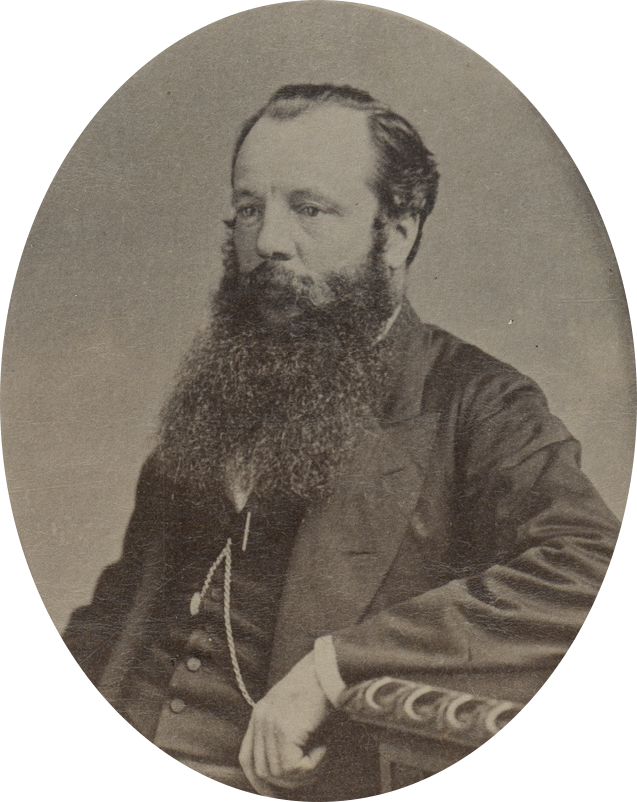
The successful purchaser was Edwin Thomas Smith, [LSG Certificate of Title 181/34, 29 August 1873] "brewer" of the [Old] Kent Town Brewery as well as Mayor of Kensington and Norwood as well as member of the House of Assembly for East Torrens, later Mayor of the City of Adelaide, a founder of the South Australian Brewing Company and philanthropist. Interestingly, Ellery's other nearby properties were bought by current or future partners or close associates of Smith: J E Moulden, his solicitor, Thomas English, one of his architect and William Roussevell, his future partner and fellow politician [ACC, Assessment Book 1874].
How Smith financed such an acquisition - and why he seemingly paid over 13 times its rated value - is unclear. His son, Talbot Smith, later recalled that "he had an enviable faculty of making money. He would...buy a house with paddock and sell the house for the same price and retain the paddock" [Mail, 12 September 1942, p.12]. As the business manager and, from May 1866, the lessee of Edward Logue's (Old) Kent Town Brewery (he did not purchase the brewery itself until March 1877), and like many contemporary brewers, Smith understood the value of the vertical integration of breweries and pubs; in the 1860s, as proprietor of the (Old) Kent Town Brewery, Smith leased and/or subleased a number of metropolitan pubs, amongst them the Lady Gowrie and the Duke of Wellington in Port Adelaide, the Huntsman in North Adelaide and the Duke of Wellington in Adelaide [Historic name search in LSG's SAILIS]. The acquisition of the Crown and Anchor could well have been a strategic purchase in order to compete with other breweries that also controlled pubs in the area. Pubs that offered clean and comfortable accommodation, stabling and refreshment especially for travellers to the East End of Adelaide would have been attractive investments in the 1860s and 1870s. By the end of the 1860s well-formed and maintained roads and bridges across the East Parklands connected the East End to growing suburbs in the north and east and farms further afield while 'nuisance' industries such as Peacock's tannery had been forced to clean up or relocate. |
|
[SLSA B 1288-6] 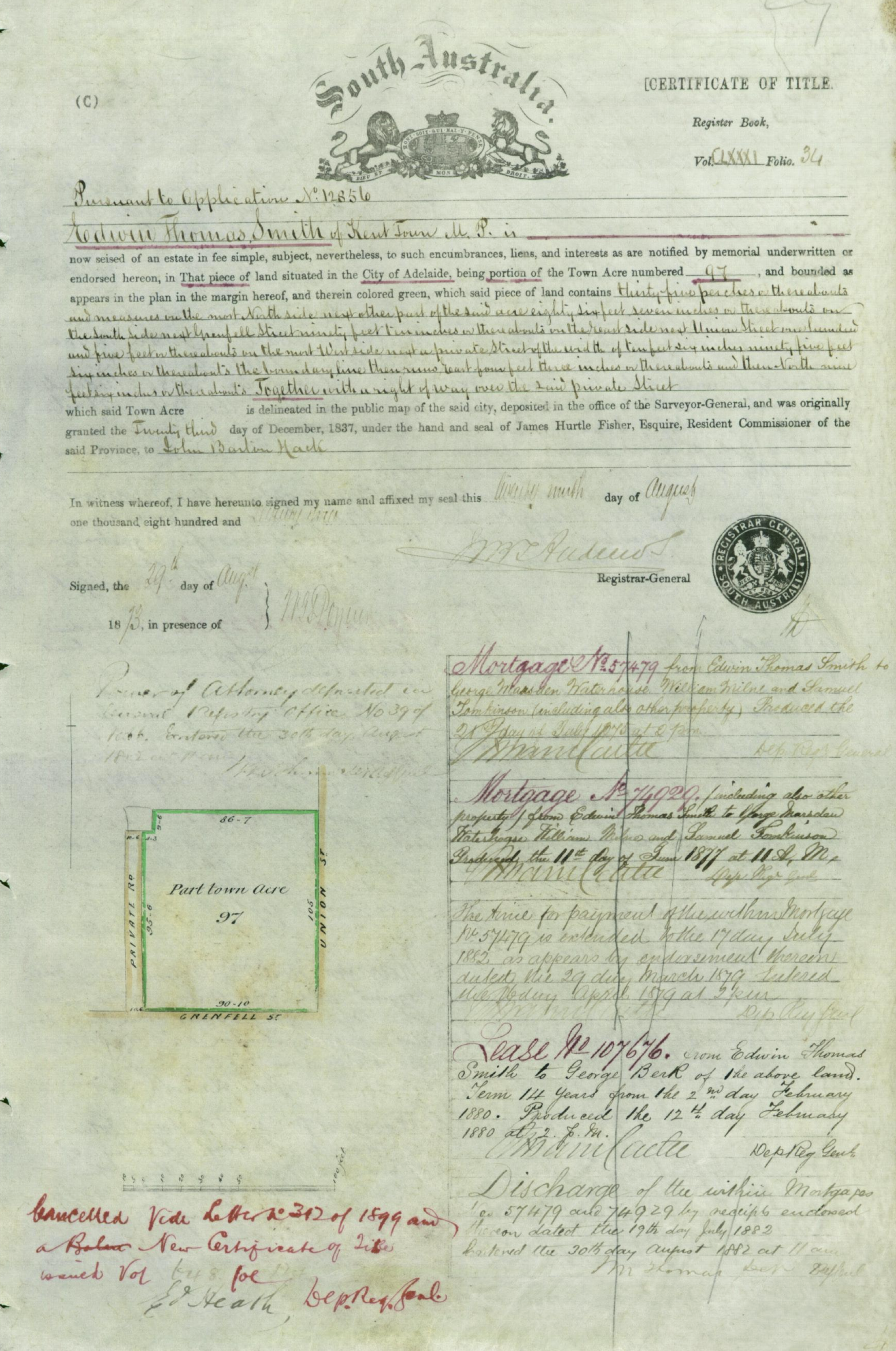
Certificates of title, 1873-1982 [LSG Certificates of Title] |
However, the major single factor was increased patronage resulting from the establishment of a major regulated fruit and vegetable exchange, the East End Market, between North and East Terraces and Rundle Street, in October 1872 and its gradual expansion over the next thirty years. To a large extent, the proliferation of new or rebuilt pubs in the East End aligned with the development of the market from the late 1860s to the first decade of the twentieth century. New pubs in the East End included the East End Market Hotel (1868), the Botanic [Family] Hotel (1877) and the Austral [Family] Hotel (1880); most existing pubs were substantially upgraded or completely rebuilt including the Tavistock (1884), the Exeter (1888), the Stag (1903) and the Woodman/Producers (1906) and the Crown and Anchor. [For more on these and other East End pubs, see the EastEnd Historic Pub-crawl.]
In March 1879 the Inspector of Licensing reported that the Crown and Anchor was one of several "houses [with] insufficient or poor accommodation and...also little or much out of repair" and that it had "bugs in all bedrooms" [Evening Journal, 14 March 1879, p.3; Express and Telegraph, 13 March 1879, p.3]. On 29 March Smith remortgaged the property presumably to at least partially finance its rebuilding [LSG Certificate of Title 181/34, 29 August 1873] and in August Thomas English, the architect of Smith's recently completed (New) Kent Town Brewery, invited tenders from builders for "rebuilding the Crown and Anchor Hotel, Grenfell Street" [South Australian Register, 13 August 1879, p.2]. Completed by the end of 1879, the Crown and Anchor was described as "a new two-story building...erected in lieu of the old single-story place. Mr English was the architect; cost about £1534". Important for over-nighting market gardeners, in March 1880 English and Soward tendered for the erection of stabling at the Crown and Anchor [South Australian Register, 10 March 1880, p.2]; in July stabling at the Crown and Anchor was offered for let, "new and commodious, numbering twenty-seven stalls. Two entrances, one off Grenfell Street and one from Union Street" [Express and Telegraph, 10 July 1880, p.1]. Although there have been periodic internal changes to the pub and the addition of verandahs and some external modernisation in 1928 [Register, 4 October 1928, p.5], the current Crown and Anchor occupies more or less the same footprint and and has more or less the same external structure as in 1880.
| In November 1880 George Beck advertised the opening of the rebuilt Crown and Anchor [Register, 29 November 1880, p.3]. Following the amalgamation of Smith's Kent Town Brewery with W K Simms' West End Brewery and other companies to form what became later the South Australian Brewing Company, in June 1888 Smith transferred the Crown and Anchor and his other pubs to the new company; it continued to own the pub until October 1982, ironically at about the same time the wholesale fruit and vegetable markets relocated to Pooraka (1988). | |
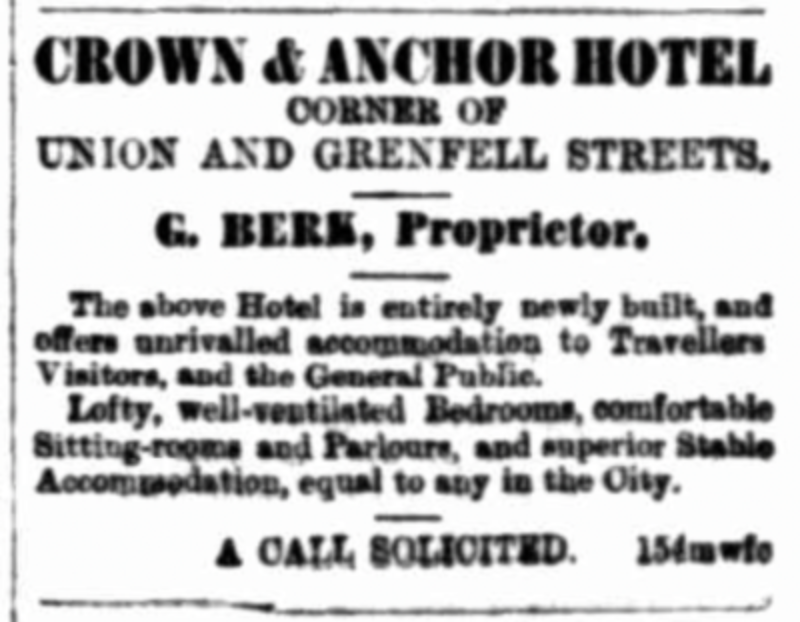
[Register, 29 November 1880, p.3] |
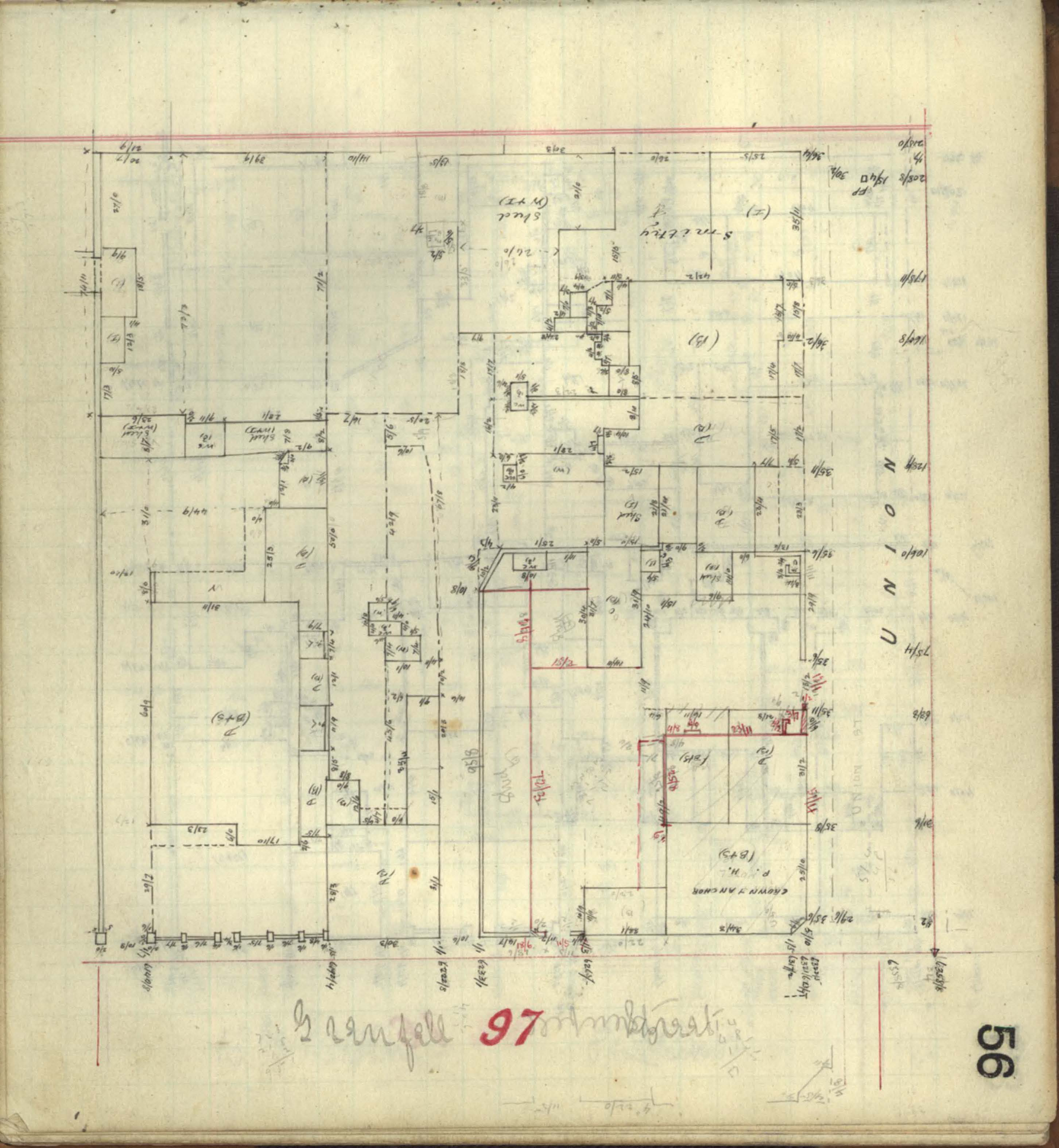
Plan of property of Crown and Anchor showing external walls, pub highlighed, 1880 [ACC [Smith's] Adelaide City Survey, Field Book, No.2, 1880] |
|
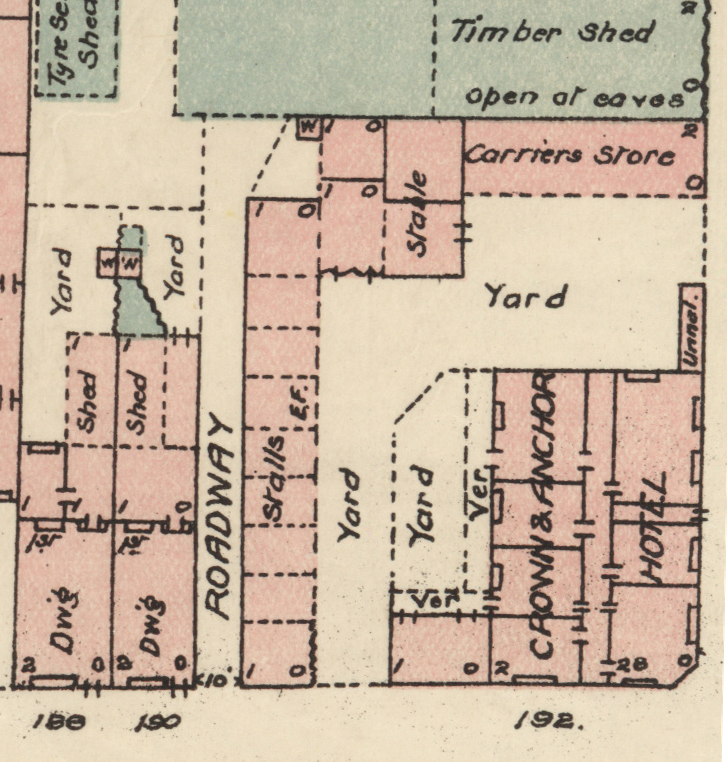
Detail of Garrett's plan of the property showing stables and storage area and the internal layout of the ground floor of the pub, 1924 [SLSA Map prepared for the Fire Underwriters Association...July 1924] |
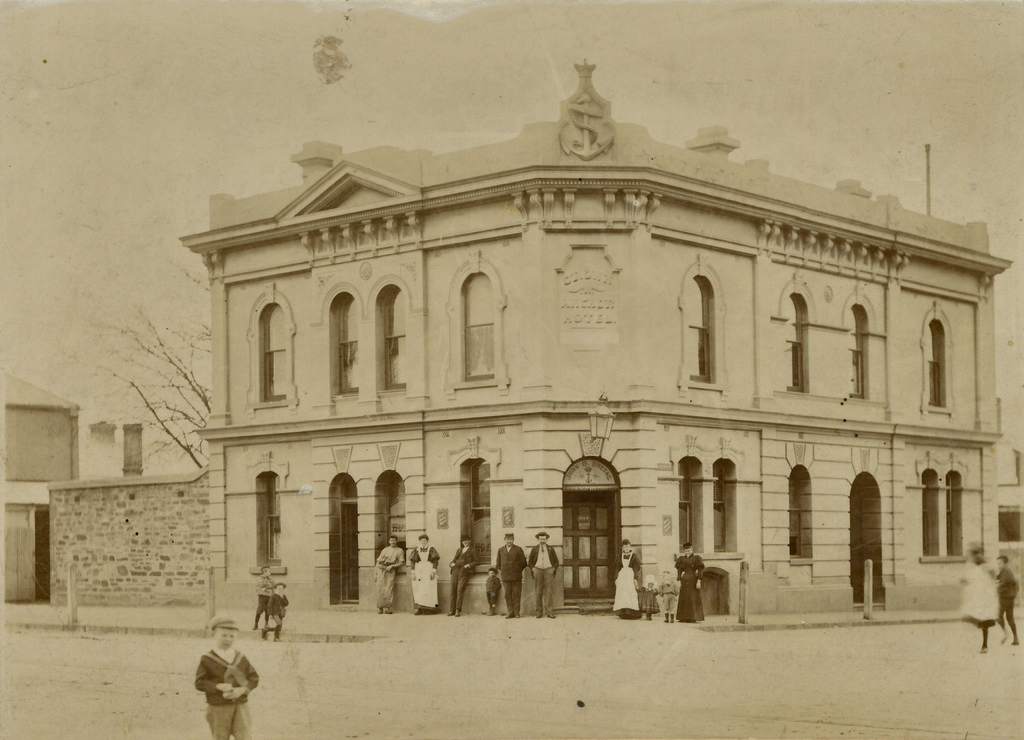
The Crown and Anchor in 1896 [SLSA B-9027] |
|
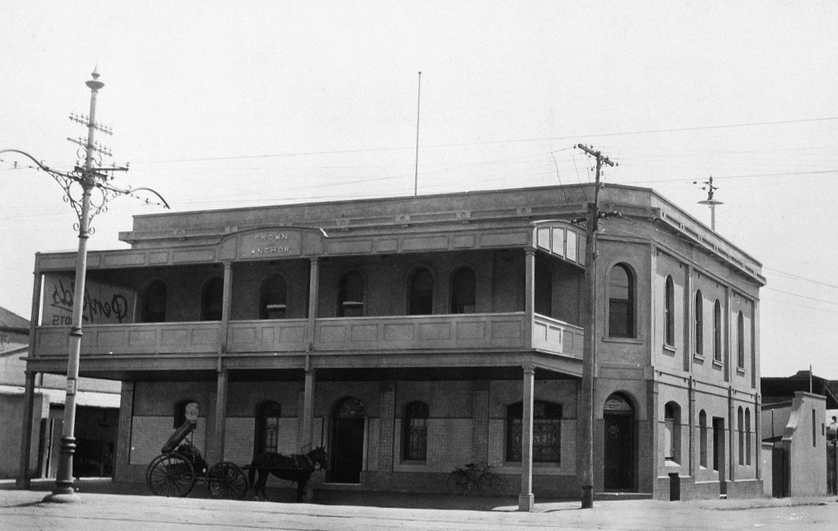
...and in about 1930 [SLSA B-5731] |
For most of its 175 or more years, the pub's 'community' was the growers and greengtocers trading at the 'unofficial' wholesale fruit and vegetable market operating behind the Stag Hotel as early as 1854 and then the regulated markets established by Richard Vaughan and William Charlick from the 1870s to the 1910s and which survived until the residential development in the 1990s. (On the markets, refer to Alexander Parson's short history of the East End Markets; also see Bill Chartre's East End Markets site for an insider's history of the markets.)
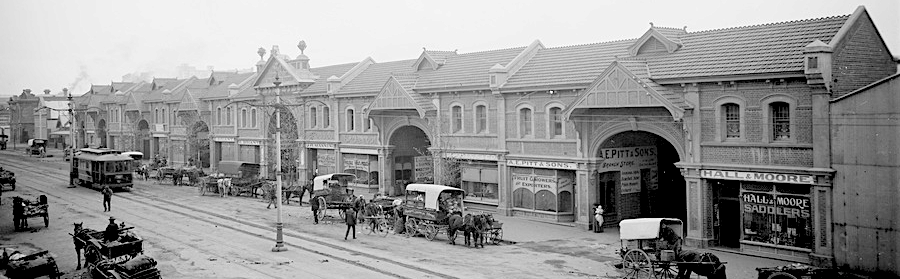
The east end of Grenfell Street, 1911. The Crown and Anchor is at the far left. [SLSA B 8527]
[Posted 27 May 2024 Original content © Craig Hill 2024]