
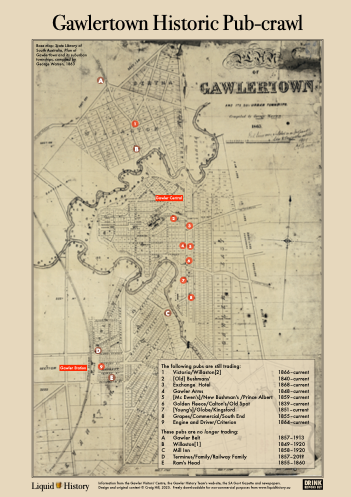
The Gawler Historic Pub-crawl is a self-guided pub-crawl through Gawlertown's historic hotels. It is freely downloadable for non-commercial purposes; click on the image above to open in a separate window. Apologies in advance for any errors.
The guide is designed to be printed on A3 paper and in colour.
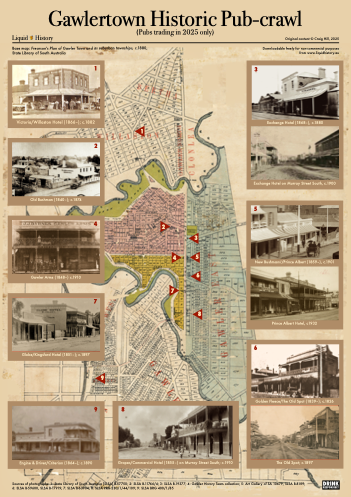
This is a "poster" version of the Gawler Historic Pub-crawl showing the locations of those Gawlertown pubs still (June 2025) trading and including old photographs of the pubs. It is also freely downloadable for non-commercial purposes; click on the image above to open in a separate window; the .pdf is a large file (44MB) and might take some time to download. The "poster" is designed to be printed on A3 paper or larger and in colour. Apologies in advance for any errors.

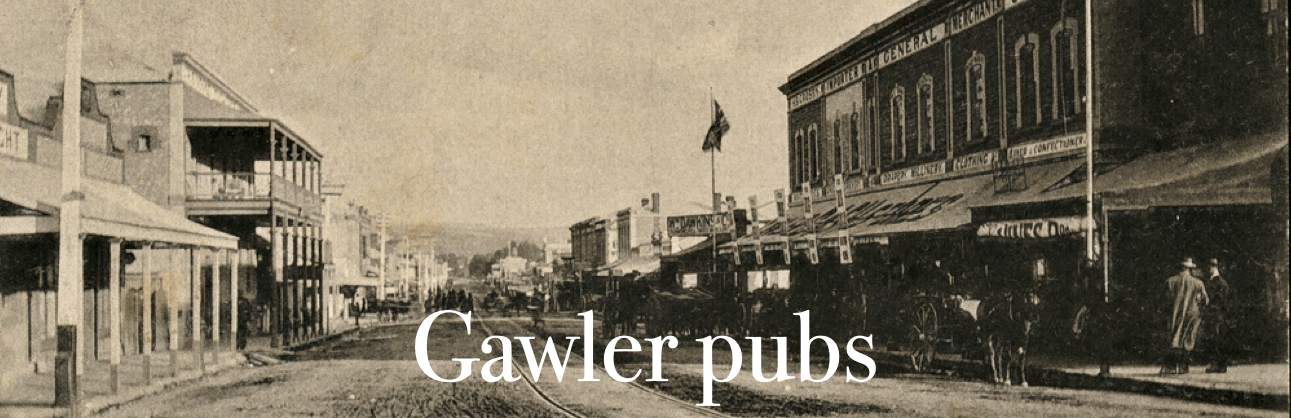
The historic pubs (and breweries) of Gawler
This is a growing collection of miscellaneous bits and pieces relevant to the history of Gawler's pubs, breweries etc. and that I believe are not - or are not readily - accessible by the public.
For information on individual pubs in and close to Gawler, please refer to the Gawler History Team's Hotels & Inns in Gawler since 1839.
Gawler's pubs and some on-going projects
After recently attending a Gawler Visitor Information Centre "Historic Hotels of Gawler Guided Walk" - highly recommended - I was intrigued by the number of colonial-era pubs...and why, in 1868, anyone would add another, The Exchange, the last of Gawler's hotels. I'm also amazed at the number still trading after at least 150 years. Consequently, I've started researching the following (and invite comments, collaboration...):
- the number of pubs in Gawler, over time, and ratio to population (pubs per 1000 population/households); comparison with the colony/state and selected metropolitan areas;
- insolvency of Gawler publicans;
- Gawler pub ownership and breweries, hotel brokers etc; correlation of brewery ownership and upgrading/rebuilding;
- with so many existing pubs, why open The Exchange?;
- alternative places to drink and socilaise (wine shades and shanties, grog shops);
- Temperance Hotels, churches and chapels and the Temperance Movement in Gawler; and
- for more personal reasons, the Auld brothers, their pubs and breweries in Gawler.
Posted June 2025 Original content © Craig Hill 2025
|
Gawler: so many pubs, so little time
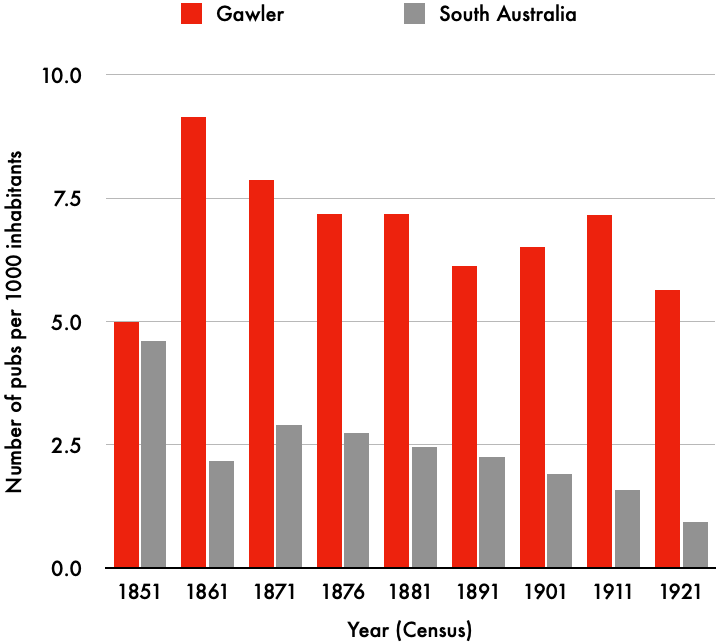
One of Gawler's attractions for the historically-minded pub-crawling visitor is the number of pubs (9) in close proximity and still trading as well as the total number (14) that have been supported by the good citizens of Gawler since the 1840s. From 1851 to 1921 (the period for which this data is available), the average number of pubs per 1000 population in Gawler was 6.9 and only 2.4 for South Australia; this prevalence of pubs in Gawler compared to the colony/state as a whole is shown in the graph at the right [1]. Why there should be so many pubs in Gawler is a question that historically-minded pub-crawling visitors might ask themselves, preferably over a pint at Gawler's first pub, The Old Spot (Golden Fleece) or Gawler's latest, The Exchange...this question and many more: was drinking/drunkenness rampant in Gawler, were all the pubs equally successful and how many of the publicans became insolvent, how many of the pubs were owned or leased by breweries, and so on. | |
|
| 1 | Statistical Register [Statistical Returns] of South Australia, 1850-51-1921; Census of South Australia, 1851-1901; Census of the Commonwealth of Australia, 1911-1921 |
Posted July 2025 Original content © Craig Hill 2025
|
The Prince Albert Hotel in c.1901
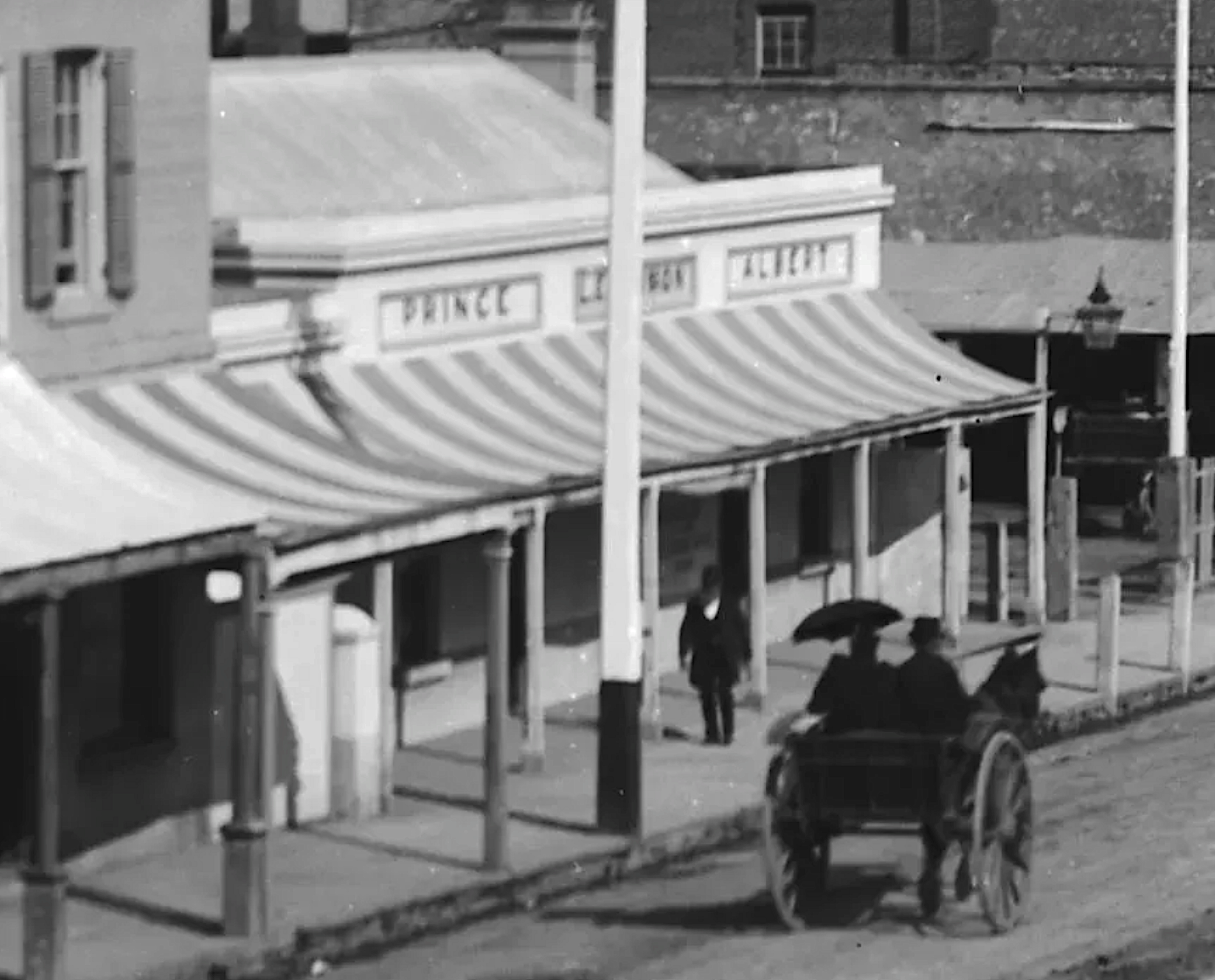
The photograph on the right shows the single-storey Prince Albert Hotel, Murray Street, Gawler in c1901; the licensee in 1901-1902 was Ludwig E. P. Simon part of whose name can be seen on the parapet. Tenders for "extensive additions" to the pub were invited in February 1902 and an effectively rebuilt two-storey Prince Albert was opened in early August. [Source: Art Gallery of South Australia: R. E. Sheedy, "Gawler main street as seen from balcony window", detail; also at State Library of South Australia B9486] | |
|
| |
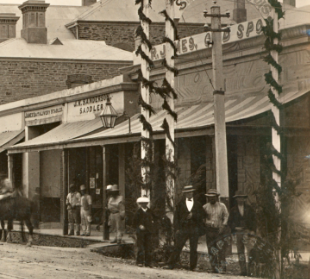
The Old Spot Hotel in 1878 The Old Spot Hotel was also originally a single-storey building, not unlike many of the stores along Murray Street. The photograph on the left shows the Old Spot pub partly obscured by street decorations on the occasion of the opening of the Gawler Town Hall and Vice-Regal visit in 1878. [Source: State Library of South Australia B10586] |
Posted July 2025 Original content © Craig Hill 2025
|
What and where was "The Swan Wine Shades"?
"Wine shades" were licensed premises in which wine could be sold and consumed; they were often located in the cellars in which the wine was stored. Probably named after the seventeenth century "Old Wine Shades" in London, by the mid nineteenth century "wine shades" was a relatively common name for a wine bar, including in colonial South Australia. At that time metropolitan Adelaide boasted, amongst others, the Vintage Shades in Norwood, the Adelaide Wine Shades in Gilbert Place, Bull's Wine Shades in Currie Street and Vaughan's "shades" in the East End Market building. Physically wine shades were little different to cafes or other shops. | |
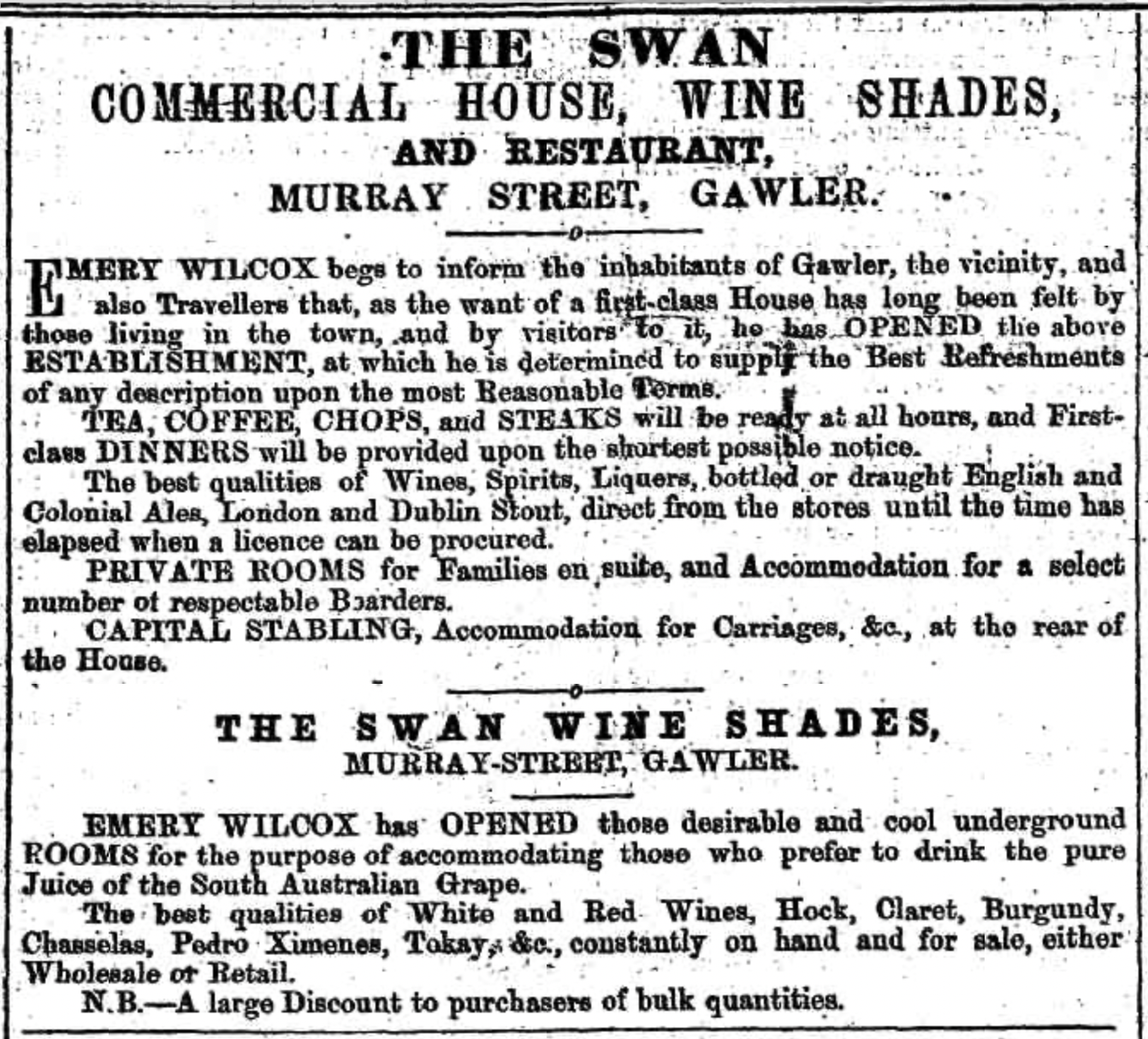
Advertisment for "The Swan" [Bunyip, 14 December 1867, p.1] |
On 9 December 1867 Emery Wilcox applied for but was refused a general publican's license for a "new house" to be called "The Swan" in Murray Street. However, on 17 December 1867, the Gawler Local Court granted Wilcox a wine license and, from mid-December 1867 until the end of February 1868, Wilcox advertised "The Swan Commercial House, Wine Shades and Restaurant", noting that liquor could be provided only from "the stores" (effectively "BYO") "until the time has elapsed that a [full] licence can be procured", presumably at the next annual general meeting of the Licensing Bench in March 1868.
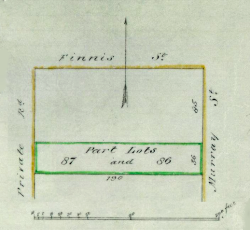 Wilcox' allotment, part lots 86 and 87
[LSSA, CT 71/128, 8 September 1866]
Wilcox' allotment, part lots 86 and 87
[LSSA, CT 71/128, 8 September 1866]
|
|
Wilcox owned an allotment, parts of Lots 86 and 87 (see left) on the western side of Murray Street and between Jacobs Street (now Lane) and Finniss Street from 15 May 1865 until 5 December 1866 when the mortgagees foreclosed and, in May 1867, disposed of his "real and personal estate". For a second time, Emery Wilcox was insolvent. Nevertheless, the Gawler Assessment Book for 1868 shows Wilcox as the occupant of a "shop and residence" on what can only be the same property but then owned by Giles & Smith, "agents" and wool and wheat merchants. Almost certainly this allotment - corresponding approximately to 136-138 Murray Street - was the presumptive site of "The Swan" and its "wine shades". It was also the intended site of The Exchange Hotel!
|
Faced with Pearce, Wincey and Co's objections, a petition of about 370 residents opposing the license and the common arguments that the proposed public house was not required, that the accommodation was insufficient for the public and it was not well situated, Wilcox' application for The Exchange Hotel was also unsuccessful; moreover he was not granted leave to reapply at the next session of the Bench. Yet, supported by a memorial of over 100 persons and a favourable police report, on 14 December 1868 the local wheat merchant Theodor(e) Kneese was granted a license for a public house to be named 'The Exchange Hotel', newly built on Lot 194, its current site. [To be continued]
Posted July 2025 Original content © Craig Hill 2025
|
The locations of Gawler's temperance hotels
Stll looking for: • Egan's "Temperance Hotel" • Dawe's "Gawler Coffee Saloon and Temperance Hotel" Might have been on the same site, possibly on Lot 6 opposite the Bankk of South Australia building on Murray Street. In any case, temperance hotels on Gawler didn't seem to last long. Posted June 2025 Original content © Craig Hill 2025 | |
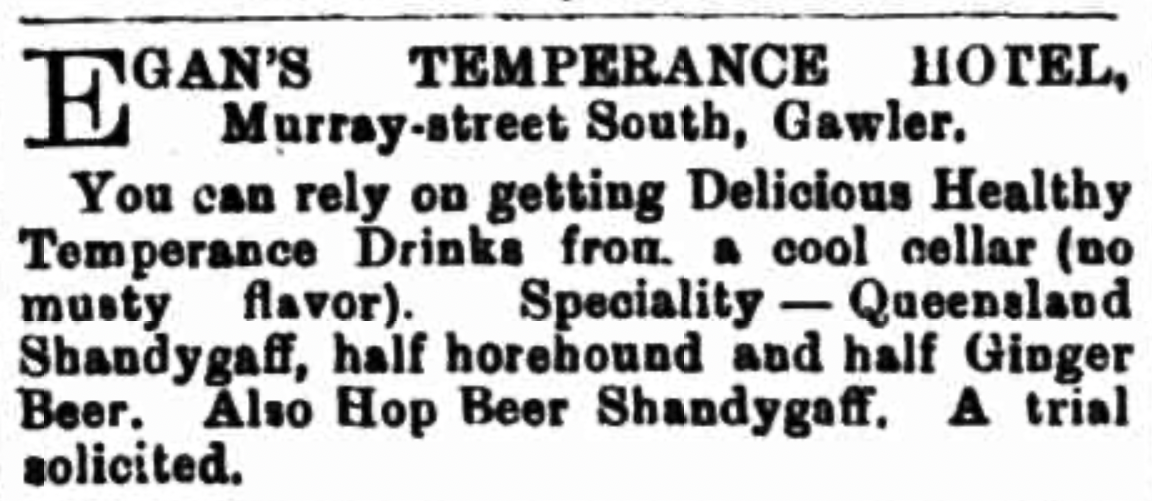
Advertisment for Egan's Temperance Hotel in Murray Street South [Bunyip, 29 October 1897, p.3] |
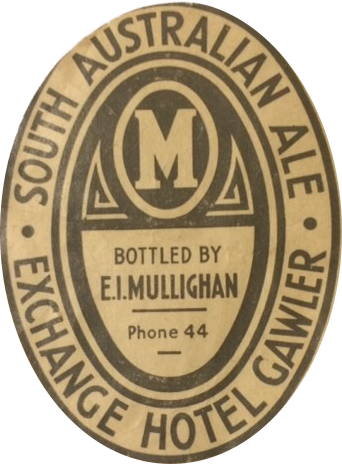
On the face of it, the label (below) for "South Australian Ale, Exchange Hotel Gawler, bottled by E[dith] I[vy] Mullighan" implies that the pub brewed its own beer. Possible but, certainly from 1946 to 1964 when Ms Mullighan was the licensee, I believe unlikely...
|
|
...and, arguably, illegal! The introduction of the brewers' colonial ale license in 1901 made it legally difficult if not impossible for a licensee to brew and sell beer, draught or bottled, in their pub.
However, as explained in Pubs & Publicans pp 14-15. South Australian publicans commonly bottled beer supplied in barrels by one or another of the breweries more often than not with labels and bottles. From 1916 six o'clock closing increased the popularity of such pub-bottled beer. However, the Exchange Hotel pub-labelled bottles more likely resulted from the extension of wartime rationing of bottled-beer and beer ingredients and sporadic shortages well into the 1950s. |
Interestingly, from 1876 until at least 1960, The Exchange Hotel was owned by members of the Fotheringham family, founders and owners of the Nottingham/Gawler Brewery (a list of the pub's owners, 1868 to 1960, is here). As a result of a series of brewery amalgamations, the brewing of beer was discontinued at the Gawler Brewery in May 1901 and subsequently Fotheringham's pubs were supplied by the Walkerville Brewery which was itself bought out by the South Australian Brewing Company in 1938. So, unless concrete evidence of brewing at the pub is discovered, the Exchange's South Australian Ale, bottled and labelled by Ms Mullighan, was much more likely to have been an austerity version of Southwark Bitter. But I could be wrong...
Posted June 2025 Original content © Craig Hill 2025
|
|
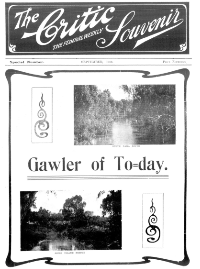
A twenty-page special feature of The Critic on Gawler in 1906. The articles focus on many of Gawler's other businesses, notably James Martin & Co's Engineering Works, and Gawler's literary societies, rather than the pubs.
Click on the image (left) to view/download the entire edition. |
Posted June 2025 Original content © Craig Hill 2025
Posted June 2025 Original content © Craig Hill 2025