

The Kent Town Hotel, 1936
D Darian Smith's photographs of Kent Town, 1836-37
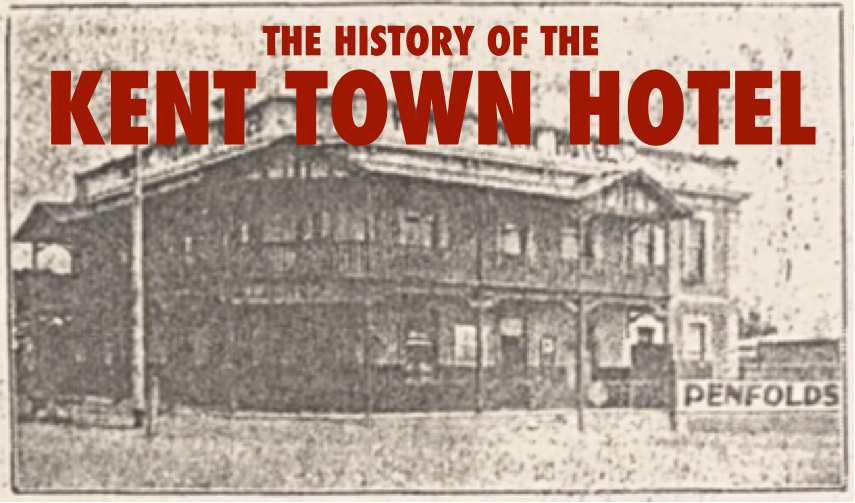
A social history of the Kent Town Hotel
An illustrated presentation given at the Kent Town Hotel in May 2025
James Chittleborough, first real publican of the Kent Town Hotel, 1856-1860
What exactly is an 'Ordinary'? A short note on eating in colonial South Australian pubs
Reading photographs of pubs: the Kent Town Hotel c. 1902
Reading another photograph of the Kent Town Hotel c. 1922

|
|
|
The Kent Town Hotel, 1937
Douglas Darian Smith's aerial photographs (below) show the Kent Town Hotel at the centre of Kent Town in 1936 or 1937. The tennis court at the rear of the pub, advertising for Penfolds Port and, below that, the outside men's urinal attached to the back of the pub are clearly visible (click on the first image to enlarge in a separate window).
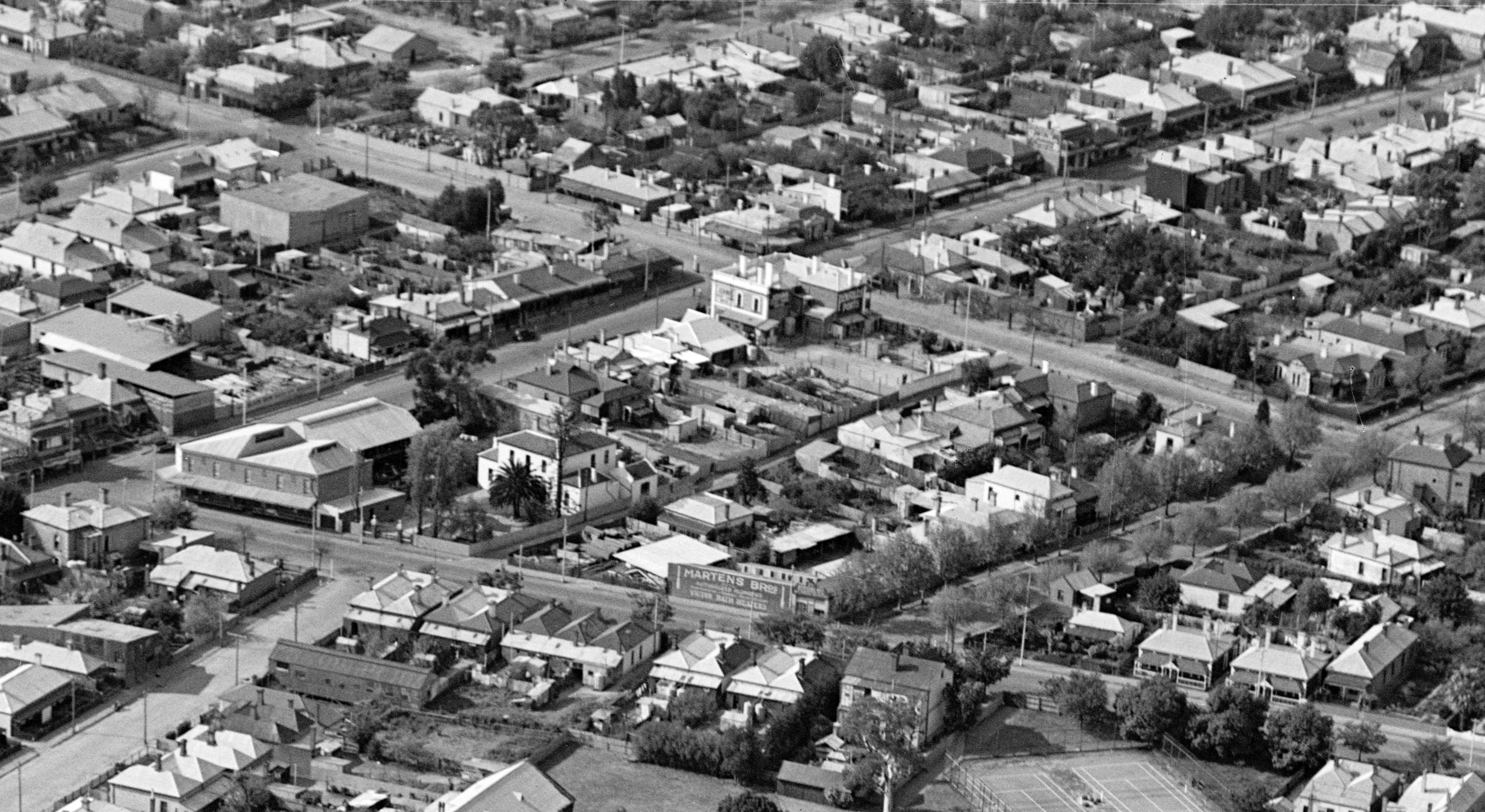 [State Library of South Australia BRG 397/2/146/1, detail only; click on the image to enlarge]
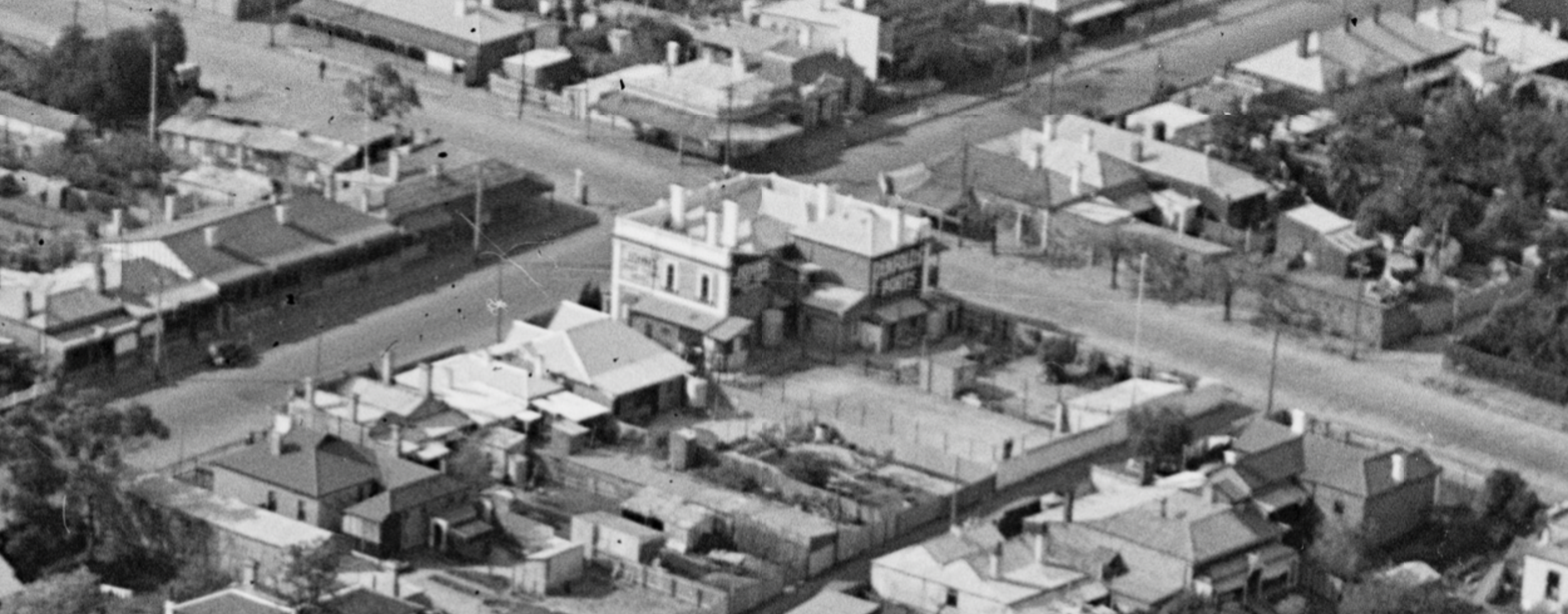 [State Library of South Australia BRG 397/2/146/3, detail only; no enlargement]
(For those interested in identifying the pub's neighbours in these photographs, refer to the Sands & McDougall's South Australian Directory for 1937, pages 228 to 231 [file pages 265 to 268]).
Posted 31 August 2025 Original content © Craig Hill 2025
|
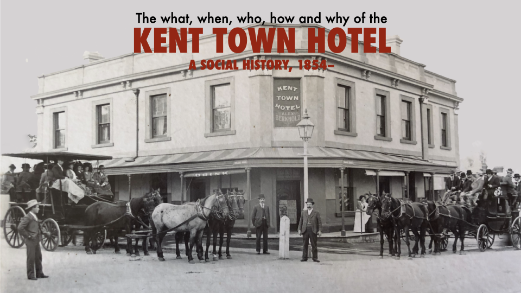
A social history of the Kent Town Hotel: an illustrated presentation given at the Kent Town Hotel in May 2025 Despite best intentions, I have had to postpone the 'scrapbook' version of the presentation until later in the year. In the meantime the presentation itself can be viewed and downloaded, "as is", in five pdf files, as listed below: |
|
|
Part 1 (approx. 19MB)
Introduction; Executive Summary; Background to the Kent Town Hotel: development and demographics of Kent Town;Patrons of the Kent Town Hotel
Part 2 (approx. 24MB)
Diversions: the Local Option poll of 1909, the nearby pubs of Kent Town, Norwood and Adelaide, the first pub in Kent Town; Foundation of the Kent Town Hotel: William Henry and Anna Sims; Owners of the Kent Town Hotel; E T Smith and the South Australian Brewing Company
Part 3 (approx. 27MB)
Publicans of the Kent Town Hotel; James and Priscilla Chittleborough (first genuine publican), Thomas Born (longest serving licensee), 'Mena' Cooling (sole female licensee of the Kent Town Hotel); Staff of the Kent Town Hotel; Barmaid (Lilly Riley)
Part 4 (approx. 24MB)
The Kent Town Hotel in the community: Social Events; 'Civics'; Politics in the pub; Lodges and other societies; Sports
Part 5 (approx. 24MB)
Building the Kent Town Hotel
My apologies again for any inaccuracy and inconvenience and I hope that you enjoy re-viewing the presentation.
Posted 31 August 2025 Original content © Craig Hill 2025
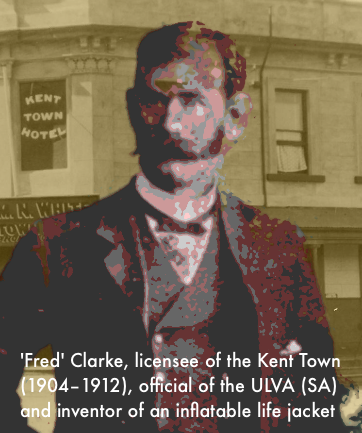
James Chittleborough, first genuine publican of the Kent Town Hotel, 1856-1860
A definitive biography of James Chittleborough Jr (c1832-1918) is yet to be written and this presentation addressed only those parts of James and Priscilla Chittleborough's lives related to the Kent Town Hotel and then only superficially. The following is offered to provide those who might be interested with a bit more information on what was a very interesting and complex life.
.jpg) | |
.jpg) | |
.jpg) "the oldest South Australia" |
The following brief account is a transcription from W Frederick Morrison's Aldine history of South Australia, illustrated (1890):
|
JAMES CHITTLEBOROUGH, Secretary of the Licensed Victuallers' Association, Adelaide, is an old colonist, having arrived in the first year of South Australia's history, viz., 1836, with Governor Hindmarsh in the " Buffalo." He was born at Portsmouth, England, in 1832, and here in the Colony was brought up to an agricultural life. On the discovery of gold in 1851 he rushed off to the Diggings, returning in 1854, having met with a fair measure of success. He then married, and became landlord of the Kent Town Hotel, and subsequently the proprietor of others in Adelaide. Later on he became a partner in Horwood's Foundry, which was one of the first established in the Colony. In 1871 he became a commercial traveller, in which pursuit he was engaged for 16 years, during which period he accepted the secretaryship of the Licensed Victuallers' Association, which position he still holds, in conjunction with the secretaryship of the Trades' Defence Association. His office in King William Street is also an Hotel Registry Office, having a connection in this business all through this Colony and, to a great extent, in the neighboring Colonies. Mr. Chittleborough, having been brought up from childhood in close proximity to the Aborigines, is looked upon as an authority in Aboriginal matters in connection with the rules and rites formerly existing about Adelaide, and he possesses a very accurate knowledge of their dialect. He has a family of five sons and three daughters, mostly grown up, one of the former assisting him in his office. In a large measure, the success of the Licensed Victuallers' Association is due to Mr. Chittleborough's efforts, its early history being a series of struggles, though now it is established on a firm financial basis.
|
A couple of detailed obituaries are here (Chronicle,9 March 1918) and here (Register,2 March 1918). Chittleborough's recollections of colonial life are here (Advertiser,29 November 1912) and here (Mail,12 July 1913) and his "Primitive Adelaide: recollections and impressions", a two-part memoir of very early Adelaide is here (Observer,29 December 1906) and here (Observer,5 January 1907).
Posted 28 April 2025 Original content © Craig Hill 2025
What exactly is an 'Ordinary'? A short note on eating in colonial South Australian pubs
The term originally referred in Britain to a tavern or inn that served a meal at a fixed price. By the end of the eighteenth century the distinction between taverns, inns, ale-houses, chop-shops and similar had more or less disappeared and the term 'ordinary' came to be applied to the meal itself.
Most simply an 'ordinary' in a colonial South Australian pub was a set-menu, fixed-price meal. It was usually but not always one or two courses and usually but not always at a set time of day, usually but not always for lunch, from noon or one o'clock. According to British pub historian David Brandon (London pubs, Apple Book edition, 2013)
|
|
[In eighteenth century Britain, an 'ordinary'] was a fixed-price set meal with a very limited choice, if any, offered on a daily basis around midday... The ordinary was usually eaten at a large communal table and beer or ale was generally taken with it. The fare consisted of a roast, perhaps a chop or two, or pies and puddings, and was food of the sort that, not altogether unkindly, used to be called 'bellytimber': a good square meal, no frills. |
What food constituted a mid-nineteenth century 'ordinary' or pub meal in South Australia is difficult to say. Pubs' advertisements occasionally specified, for examples, "hot joints [ie roasts]" or "an ordinary consisting of the delicacies of the season" and periodically listed the variety of meals available; testimonials compared favourably the fare at colonial South Australian pubs with the food that would have been familiar in English inns. However not all were so enthusiastic; in 1839 the traveller T Horton James and his companions enjoyed a meal at Philip Levy's Southern Cross Hotel:
|
|
... they enjoyed the dinner, or table d'hôte, though it consisted merely of a baked leg of mutton at the top, with a baked shoulder at bottom, and a dish of small potatoes in the middle, nothing else whatever, neither pie, pudding, or cheese...[but] a bottle of Barclay and Perkins [ale] at dinner restored them to good humour. They found that the company at the table was much better than the dishes. |
Although often overlooked, an area dedicated to 'eating' - generally the 'dining room' - was as intrinsic to South Australian pubs as the front bar. From 1839 to 1908 South Australian licensing legislation required that publicans "receive and provide for travellers", including the provision of food (and hay for travellers' horses). As Daryl Thompson and James Smith argue, "inns, taverns and public houses were certainly the first commercial suppliers of meals in early Adelaide, following the traditions of Britain..." [Traces: where Adelaide ate out, 1836-1960, 2015, p.1] and, as their book shows, the importance of pubs as suppliers of inexpensive casual meals continued and continues despite the rise of alternatives such as restaurants, cafes and bakeries. And 'ordinaries' have been replaced by 'counter-lunch', 'carveries', 'smorgasbord', 'buffet' and, most recently, 'burger-and-beer' specials.
For more information on food in Australian pubs although no mention of 'ordinaries', see Kirkby, D., Luckins, T., McConville, C., The Australian Pub (2010) in passim. For more on food in Adelaide pubs and other eating places, see Thompson, Darryl J. and Smith, James S. Traces : where Adelaide ate out 1836-1960 (2015)
Posted 13 January 2025 Original content © Craig Hill 2025
Reading photographs of pubs: the Kent Town Hotel c. 1902
Several people have asked about the photograph used to publicise this talk, why I date it at about 1902 or 1903 (not 1890 as on the wall of the gaming room at the 'Kent Town'), who were the two bowler-hatted men in the centre of the photograph and where were all those people going in the horse-drawn charabanc and carriage. The following is my reading of the photograph; some of it is highly speculative.
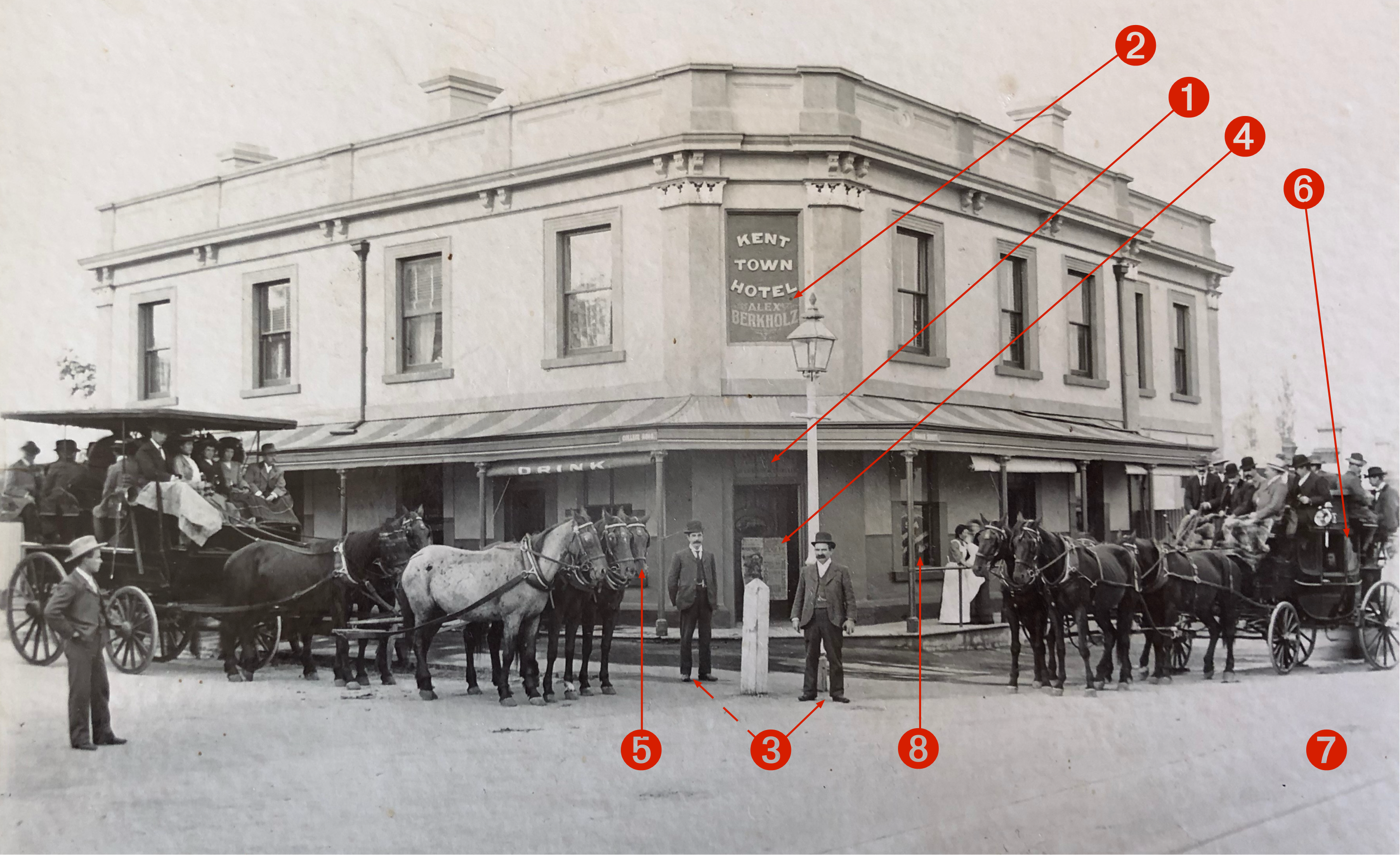
[Click on image or here to enlarge]
Since 1839 pub licensees have been required to display their name and function in a specified format "on some conspicuous part of the front of his[sic] licensed house", most often over the main entrance to the front bar; in this photograph this (1) is all but illegible. Fortunately the main sign for the Kent Town Hotel (2) includes what we can only assume is the current licensee's name: 'Alex Berkholz'. Alexander Herman Berkholz (also known as Herman Alexander Berkholz) licensed the Kent Town Hotel from June 1901 until September 1903, and not in the 1890s or any other time. The photograph was, therefore, taken in 1902, ∓1 year.
When the photograph was taken Herman Alexander Berkholz (1860-1916) would have been about 42 years old. As was common in early photographs of pubs, it is possible that the figure on the right in front of the pub (3) was the licensee, Alexander Berkholz. Not so likely is the lookalike on the left (Berkholz had no brother and in 1902 his eldest son was only twelve or thirteen). I have not found any other corroborative photographs of Berkholz and, to be honest, walrus moustaches, bowler hats and fob-watches were common male fashion statements at the time. Berkholz is therefore my best guess.
My thoughts on the circumstances for the photograph are even more speculative. Like many pubs, the Kent Town served as a meeting point for 'outings' or 'picnics' for sporting and social club, the Duke of Kent lodge or similar organisations. The poster, unfortunately also illegible, on the front door of the public bar and possibly announcing the closure of the pub for the day, suggests that this particular event might have been the annual picnic of either the Liquor Trade Employees' Association or the Licensed Victuallers' Association. Both of these typically attracted over 500 and as many as 2000 revellers in the early 1900s. They were held on private properties at Tea Tree Gully or Happy Valley or at the Belair National Park or similar; the a 'pickaxe' rig (5) - an extra horse - hints that the picnic ground was in the 'Hills', not at the beach. Finally the elegance of the carriage (6) suggests that it was provided by an affluent supporter, possibly E T Smith, retired founding Director of the South Australian Brewing Company, or W H Beaglehole, Chairman and Managing Director of the Lion Brewing and Malting Company.
Two more interesting details on the photograph: Firstly, the horse-drawn tram tracks which can be seen in the right hand foreground of the photograph (7) were installed in 1878 and removed when the electric trams were introduced on the 'Kensington' line in 1908-1909 and the line was re-routed down what is now Parade West. Secondly, the decal on the window right of the main door (8) is mostly obscured but looks like an advertisement for the 'Ales' of the SA Brewing and Malting Company which became the South Australian Brewing Company in 1893 and which, when the photograph was taken, leased the pub from its owner, Mrs Ann Simms, wife of the founder. Coincidentally, about the time the photograph was taken, SABco installed the König Lager Brewing System in its West End (Hindley Street) brewery and so began the decline of traditional ales and the steady rise of locally brewed 'lagers'.
[A rough chronology of the South Australian Brewing Company is here.]
Posted 15 January 2025 Original content © Craig Hill 2025
Reading another photograph of the Kent Town Hotel, c.1922
The sign over the main entrance to the front bar of the pub (1) shows that, at the time the photograph was taken, the licensee of the Kent Town Hotel was William Nelson White. He held the license for just 14 months, from April 1922 to June 1923.
Although the exterior of the pub remained essentially the same as in the photograph taken twenty years earlier [above], there are several noteworthy differences. Firstly the lamp post has been removed (2). The Licensing Act of 1839 required publicans to keep alight a lamp from sunset to sunrise throughout the year. However the Licensing Act of 1908 allowed that, in corporate towns such as Kensington and Norwood, license holders had to maintain a lighted lamp "continuously from sunset during such time as [she/]he is authorised to keep such house open for the sale of liquor". With the introduction of six o'clock closing in 1916, the licensing Act of 1917 conceded that "no person holding a publican's licence shall be liable to a penalty by reason of [her/]his lamp having ceased to be alight after six o'clock in the evening". Since the sun set well after five o'clock even in winter, this was unworkable. Although publicans were technically required to keep a lamp in front of their licensed premises until at least 1938, the introduction of electrical street lighting at street corners in the 1920s rendered pub lamps practically unnecessary and, I understand, there were no lamp-related prosecutions after 1932. Despite extensive searching I have been unable to determine exactly when statutes relevant to pub lamps were repealed; however, the requirement to keep a lamp was not included in the Licensing Act of 1967 which consolidated all previous legislation.
Also removed are the tram tracks visible in the 1902 photograph (6). According to local historian Ian Pascoe, the horse-drawn trams that had served the eastern suburbs from 1878 were replaced by electric trams from March 1909. In Kent Town the new route ran down Rundle Street only to what is now Parade West, not past the Kent Town Hotel and the rails were eventually removed.
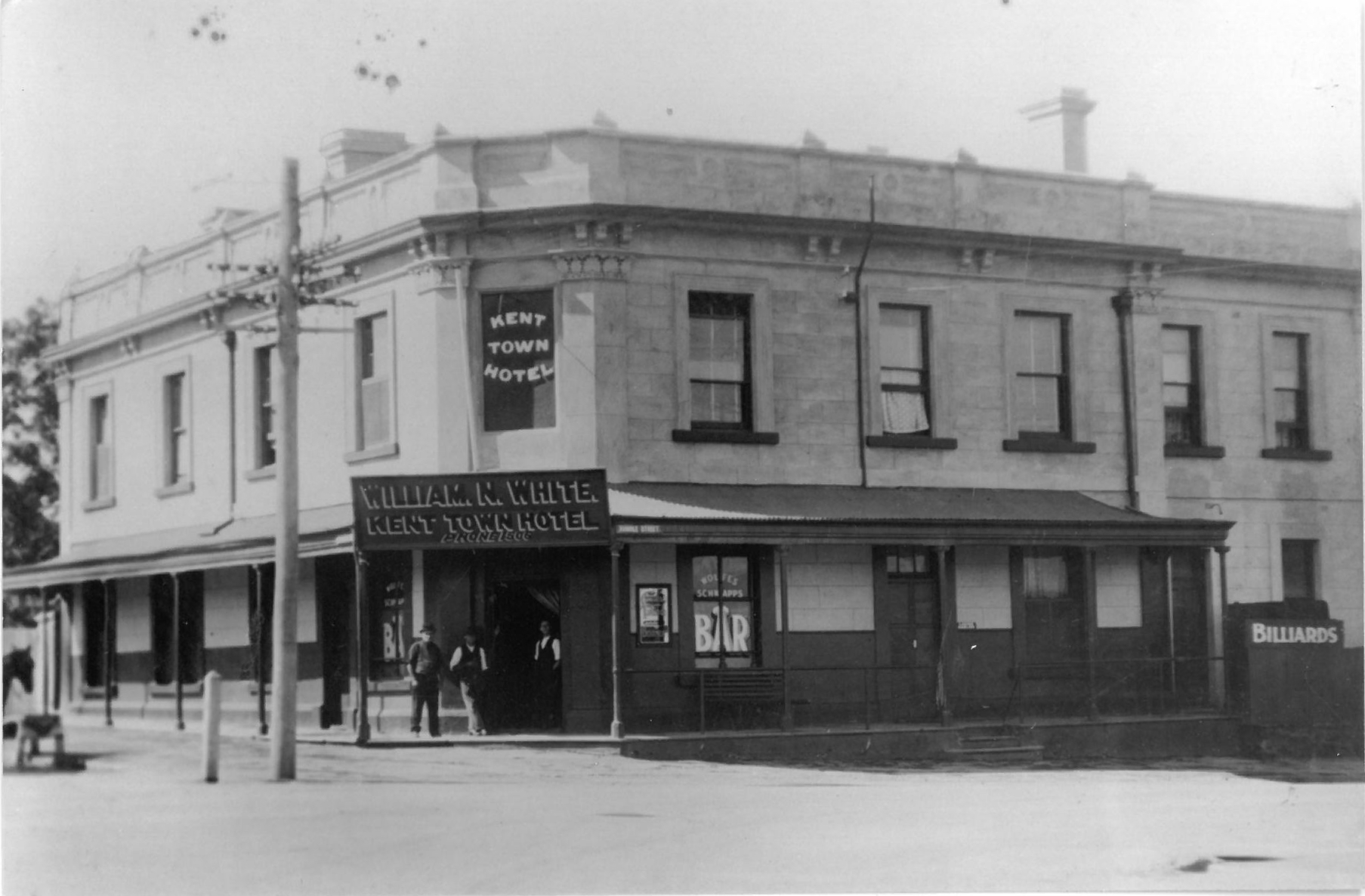
[Click on image or here to enlarge]
The same electrification that allowed for electric trams in the eastern suburbs also bought electric power and lighting. The 1922 photograph shows a power pole and the connection to the pub (3). Again according to Ian Pascoe, Kent Town was 'electrified' by 1906-07, arguably the most transformative technological innovations of the twentieth century. For the Kent Town pub connection to the electrical grid meant refrigeration of food and this new-fangled cold 'lager' beer on the one hand and the telephone on the other. Private telephony was introduced in Adelaide as early as 1883; however its adoption was dependent on the expansion of the 'grid' which preceded full mains power and the tram network. Consequently it was not until June 1904 that Kent Town Hotel was connected to the telephone network. Its number (4), 1506 (without any prefix), indicated that it was one of the first 1600 subscribers and that it was connected directly to the central exchange. One consequences of the pub having the telephone and possibly a 'wireless' radio was SP [starting price] betting; it is perhaps not coincidental, therefore, that, in September 1922, White was prosecuted - unsuccessfully - for having allowed betting to take place on his premises in what was described as the Kent Town or "The Mob are Windy" case.
One of the hotel's several outside and "public" urinals can be seen at (5), one of the pubs more salubrious but less obvious community services.
A final and speculative observation: the direction and strength of the shadows suggest that the photograph was taken early in the day during the summer of 1922-23 when Adelaide experienced multiple daily maxima over 40℃. This might explain the open windows on the upstairs rooms on the Rundle Street side of the hotel.
Posted 12 May 2025 Original content © Craig Hill 2025